
The Weather Number We’ve Been Ignoring
Dew point may be the overlooked weather number that helps explain why racing pigeons struggle on some seemingly mild days and thrive on others.
Why Dew Point Matters More Than Most Fanciers Realize
By Drew Lesofski
Editor, Racing Pigeon Digest
After racing pigeons for more than two decades on the Eastern Seaboard, in the Washington, D.C. area, I learned something about weather:
The thermometer doesn't always tell you how hard the day is going to be.
Anyone who races pigeons in a high-humidity region—whether that moisture comes from the Gulf or Atlantic, large lakes, irrigated valleys, or even dense corn country where growing crops add moisture to the air through evapotranspiration—knows how different a muggy morning can feel. It doesn't matter whether you're racing in Louisiana, Florida, Missouri, California, around the Great Lakes, or in the Washington, D.C. area. High moisture in the atmosphere changes the feel of the day.
Washington sits between the Blue Ridge and Appalachian Mountains to the west and Chesapeake Bay and Atlantic influences on the east. Weather moving through the region can weaken, rebuild, split north or south, or seemingly appear out of nowhere.
You could wake up to a relatively cool morning and still walk outside feeling like the air was wrapped around you.
That was why many of us trained early.
Very early.
We understood heat. We understood humidity. We understood thunderstorms.
But I don't remember many pigeon men talking about dew point.
Today, I think we should.
That subject came back to me recently during a conversation with a prominent Midwestern racing fancier who has paid close attention to weather and pigeon performance for years.
He told me dew point is one of the numbers he watches closely. For him, 60°F has become a personal caution line. Once the dew point starts moving above 60, particularly with rising temperatures and little air movement—he begins watching the birds much more closely. In his experience, pigeons have a harder time as those conditions become more demanding.
That caught my attention.
He wasn't presenting 60°F as some scientifically proven magic number, and neither should we. It was the observation of an experienced racing man who had been watching something for years that many of us—including me—had largely overlooked.
The conversation caused me to start asking other fanciers around the country and overseas what they were seeing. One thing became apparent: nearly everyone talks about temperature, wind, humidity, storms and visibility.
Far fewer routinely look at the dew point.
Yet dew point may help explain some of those mornings when the temperature looks perfectly reasonable, but the pigeons simply don't seem comfortable working.
What Is Dew Point?
In simple terms, dew point tells you how much moisture is actually in the air.
Technically, it is the temperature at which the air becomes saturated and moisture begins to condense.
You've seen it a thousand times.
Walk outside early in the morning and see dew covering the grass.
Drive through a river bottom and suddenly hit a wall of fog.
Look across a valley and see fog lying against the ground while the hills above remain clear.
You may even have seen it inside your pigeon loft.
This can be particularly noticeable in one-loft race lofts built with metal siding that isn't insulated or backed with wood. On certain cool, humid mornings, moisture can collect on the inside of those metal panels and literally run down the walls.
That happens when the metal surface becomes colder than the dew point of the air inside the loft. Moisture condenses on that cold metal just as water forms on the outside of a cold glass.
Remember, the pigeons themselves are adding moisture to the loft through respiration and droppings. Put a large number of birds in a loft with high outside humidity, cool metal surfaces and inadequate air exchange, and condensation can become very visible.
It is one of the easiest ways for a fancier to actually see what dew point means.
Fog works on the same principle. When the air temperature and dew point come together, the air reaches or approaches saturation and moisture condenses.
One important distinction: fog does not necessarily mean the dew point itself is extremely high. A cool morning can produce fog at a relatively low dew point.
For the pigeon fancier, the two conditions raise somewhat different concerns.
Fog creates an obvious visibility and navigation concern.
A high dew point combined with heat creates more of a cooling, workload and recovery concern.
Sometimes we get both.
Those are mornings when I am in no hurry to put pigeons into the air.
Two Mornings — Same Thermometer, Different Day
Here's the kind of morning I'm talking about.
You walk to the loft at 6:30.
Temperature: 68°F.
Doesn't sound bad.
But the dew point is 67°F.
The grass is soaked. There may be fog sitting in the low ground. There isn't a breath of wind.
You let the pigeons out.
They circle.
They aren't sick.
They aren't necessarily out of condition.
But they don't have that snap.
They don't climb.
They don't range.
Twenty or thirty minutes later they're thinking about the roof.
Now compare that with another morning.
Temperature: 80°F.
Dew point: 48°F.
There's a light breeze and dry air.
Those same pigeons may want to fly.
That's why temperature by itself can fool you.
Think About What the Pigeon Is Doing
We sometimes describe a racing pigeon as almost being a "flying lung."
Obviously, that's an exaggeration, but there is some truth behind the image.
In birds, the lungs together with the extensive air-sac system can occupy roughly one-fifth of total body volume. The air sacs function much like bellows, continually moving air through the bird's small, rigid and extremely efficient lungs.
Everything about that system is designed for flight.
And during sustained flight it works tremendously hard.
Researchers studying trained pigeons in free flight have measured breathing rates averaging roughly five to six breaths every second.
Not five breaths a minute.
Five or six every second.
Now put that pigeon on the wing for four, six, eight or ten hours.
The breast muscles are generating enormous amounts of heat.
The heart is working.
The respiratory system is working.
The bird has to continue producing energy while somehow getting rid of the heat that energy production creates.
Put that respiratory system on the wing for six or eight hours and suddenly atmospheric moisture isn't an abstract weather statistic.
It matters.
Pigeons Don't Sweat
A pigeon doesn't cool itself the way you and I do.
It can't soak a shirt with sweat.
Instead, pigeons depend heavily on evaporative cooling. They lose heat as moisture evaporates through the respiratory system and, importantly, through the skin.
When a bird becomes sufficiently hot, it can also begin rapid panting.
Every pigeon man has seen it.
A bird comes home, lands with its wings slightly away from its body, its beak open and breathing hard.
Some fanciers immediately think:
That bird is fat.
Maybe.
Maybe the pigeon is short of condition.
Maybe it worked extremely hard.
But don't overlook the weather.
A high temperature combined with a high dew point may mean that pigeon had a much harder time shedding the heat it produced during flight.
As moisture in the atmosphere increases, evaporation becomes less efficient.
The bird can still cool itself, but the environmental margin becomes smaller.
Studies involving pigeons have shown that both respiratory and skin evaporative water loss can decrease as atmospheric humidity increases.
That should interest every racing pigeon fancier.
What We Mean by "Heavy Air"
Pigeon men have been saying it forever: “The air was heavy today.”
We know exactly what that means from experience. The birds may not climb as readily, they may not range as well, and the work seems to cost them more.
Scientifically, humid air is not literally too thick for a pigeon to breathe or fly through. The real issue is that a bird in sustained flight is producing a tremendous amount of heat, and high atmospheric moisture can make it harder to get rid of that heat efficiently.
Now add direct sunshine, little air movement, a headwind, hours on the wing, and the gradual loss of water that comes with hard flight. If the dew point is also high, conditions that may have looked ordinary on a weather app can become much more demanding for the pigeon.
That is what many of us are really describing when we say the air feels “heavy.”
Weather works in combinations.
Conditioning Still Matters
The Midwestern fancier who started me thinking more seriously about dew point made another observation that will sound familiar to experienced pigeon men.
In his experience, pigeons that are working hard around the loft every day are better prepared to deal with demanding training and racing conditions.
He described vigorous loft flying as helping to "open up" the pigeon's air sacs.
I understand exactly what he means from a fancier's standpoint, although physiologically I would phrase it somewhat differently. The air sacs themselves aren't muscles that simply become larger or stronger through exercise.
What regular, vigorous loft flying does is condition the entire system supporting flight—the heart, circulation, flight muscles, respiratory system, metabolism and the bird's ability to sustain a heavy workload.
His larger point is a good one:
You cannot control the dew point, but you can control how well prepared your pigeons are when they meet it.
A high dew point isn't an excuse for poorly conditioned pigeons.
But neither can conditioning change the atmosphere.
You can build the engine.
You can't change the air in which that engine has to operate.
Watch Your Own Team
This may be where dew point becomes most useful.
Don't take my word for it.
Watch your pigeons.
For a month, keep a simple record when they loft fly:
• Temperature
• Dew point
• Wind
• Sky conditions
• How long they flew
• How they acted when they landed
Especially watch the mornings when the team doesn't want to work.
Was the dew point 48°F?
Or was it 68°F?
Then watch them after they land.
How quickly do they recover?
Are their mouths open?
Are several birds breathing rapidly?
Do they immediately go for water?
Are they comfortable five minutes later, or are they still working to shed heat?
You may start seeing a pattern.
And remember this distinction:
If one pigeon is standing there panting while nineteen others are perfectly comfortable, I wouldn't immediately blame the dew point.
I'd look at the pigeon.
But if the entire team comes down from an ordinary loft fly and several birds are breathing harder than you would expect, look at the weather before deciding your whole team suddenly lost condition.
Sometimes the birds are telling you something about the atmosphere.
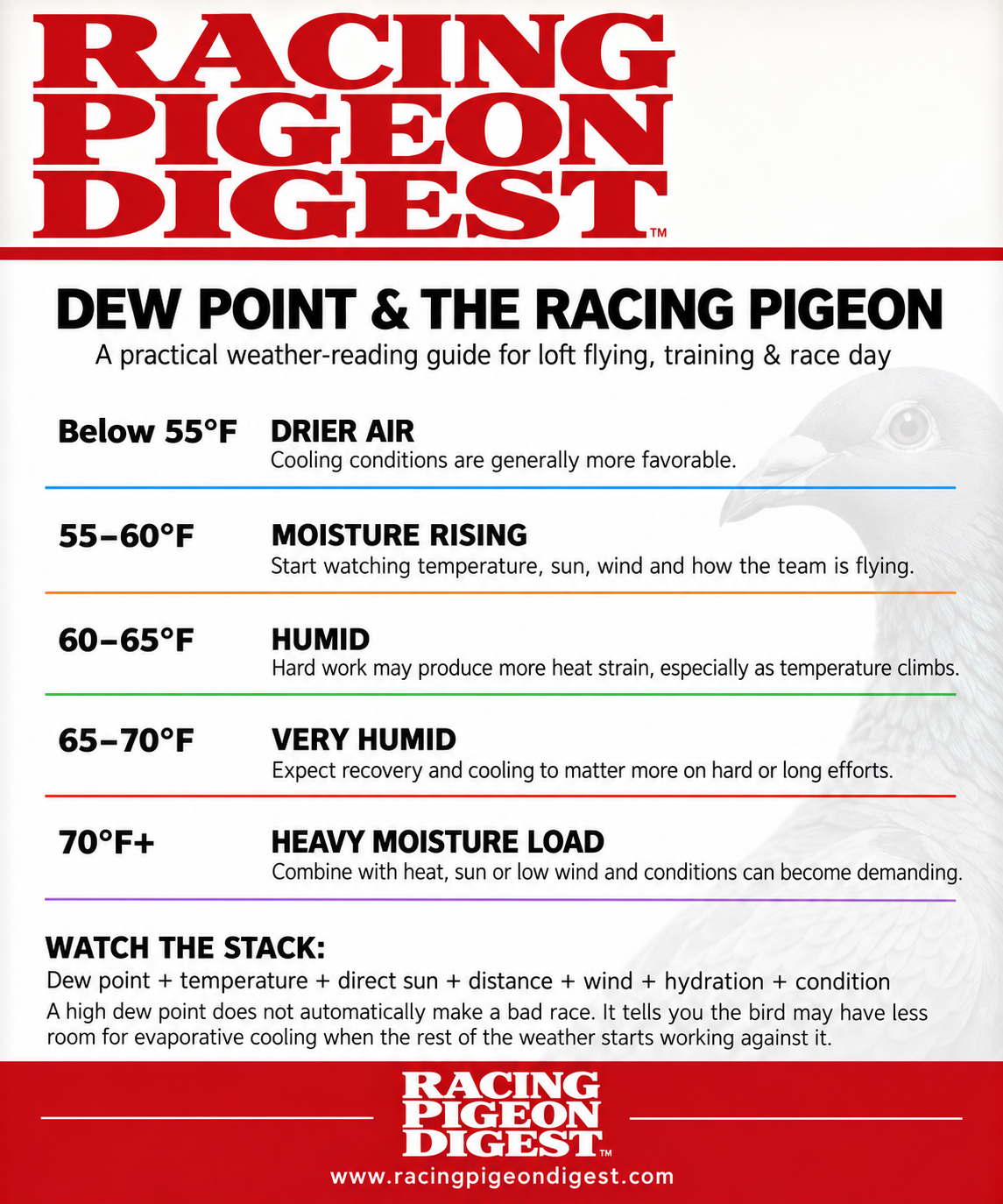
A Practical Dew-Point Guide
These are not scientifically established biological limits for racing pigeons. Think of them simply as a practical way of adding dew point to your weather assessment.
Below 55°F — Generally favorable
Relatively dry air. Evaporative cooling conditions are generally more favorable.
55–60°F — Start watching
Moisture is increasing. Look more closely at temperature, sunshine and wind.
60–65°F — Humid
This is where I start paying considerably more attention, particularly as temperatures climb.
65–70°F — Very humid
Add strong sun, little wind, distance or a headwind and the workload can become much more demanding.
70°F and above — Pay close attention
There is a lot of moisture in the atmosphere. When this combines with heat and several hours of work, conditions deserve respect.
Remember the Midwestern fancier I mentioned earlier?
His personal warning line is around 60°F.
Science doesn't establish 60 degrees as a hard racing-pigeon cutoff, but his years of observation give us a useful place to start watching our own birds.
A 68°F dew point on a cool morning with a strong tailwind isn't the same thing as a 68°F dew point with temperatures approaching 90°F, full sunshine and a headwind.
Again:
Don't judge the race by one number.
Follow the Weather Along the Race Course
There is another mistake we can make.
We look at the weather at the liberation point.
Then we look at the weather at home.
What about the 300 miles in between?
On a 300, 400 or 500 mile race, pigeons may cross several different weather zones during the course of a single day.
A good race-day assessment should look at the hourly dew point, temperature, wind, cloud cover and potential weather changes along the entire line of flight, not simply where the truck doors open.
This becomes especially important on middle and long-distance races.
We stand outside at 7:00 in the morning and say:
"It's beautiful out."
Maybe it is.
But where will the pigeons be at noon?
What will the temperature be at 2:00?
What will the dew point be?
How much wind will they have?
How much sun?
The bird competing for seven hours doesn't race in the weather you experienced drinking coffee at liberation time.
It races through the weather of the entire day.
That's a very different thing.
Add One Number
For years most of us have looked at:
• Temperature
• Wind direction
• Wind speed
• Chance of rain
• Visibility
I would add one more:
DEW POINT.
It won't tell you who is going to win Saturday's race.
It won't replace good pigeons, conditioning, health, feeding or good judgment.
But it may help explain why one 75-degree day produces beautiful racing conditions while another 75-degree day feels like the pigeons are carrying an extra passenger.
The Midwestern fancier who first pushed me to think harder about dew point may have been watching that 60-degree line for years while many of us were still looking only at the thermometer. I still would not call 60°F a magic number, and neither should you. But I do believe dew point deserves a place beside temperature, wind, visibility and distance when we evaluate a training day or a race. Write it down. Watch your pigeons. Compare it with loft exercise, race velocity and recovery. Over time, your own birds will tell you whether there is a pattern. After more than two decades racing in the heat and humidity around Washington, D.C., I wish I had paid more attention to it earlier. The number was always there—we just weren't looking at it. The thermometer tells us how hot the air is. The dew point tells us how much moisture is riding along with it. For a racing pigeon working hour after hour on the wing, that is information worth having.