
Baking Soda and Racing Pigeons: The Old Secret for Faster Recovery
An old, inexpensive recovery secret that some of the sharpest fanciers have used for generations - and what the science actually says about when, how much, and why.
By Drew Lesofski
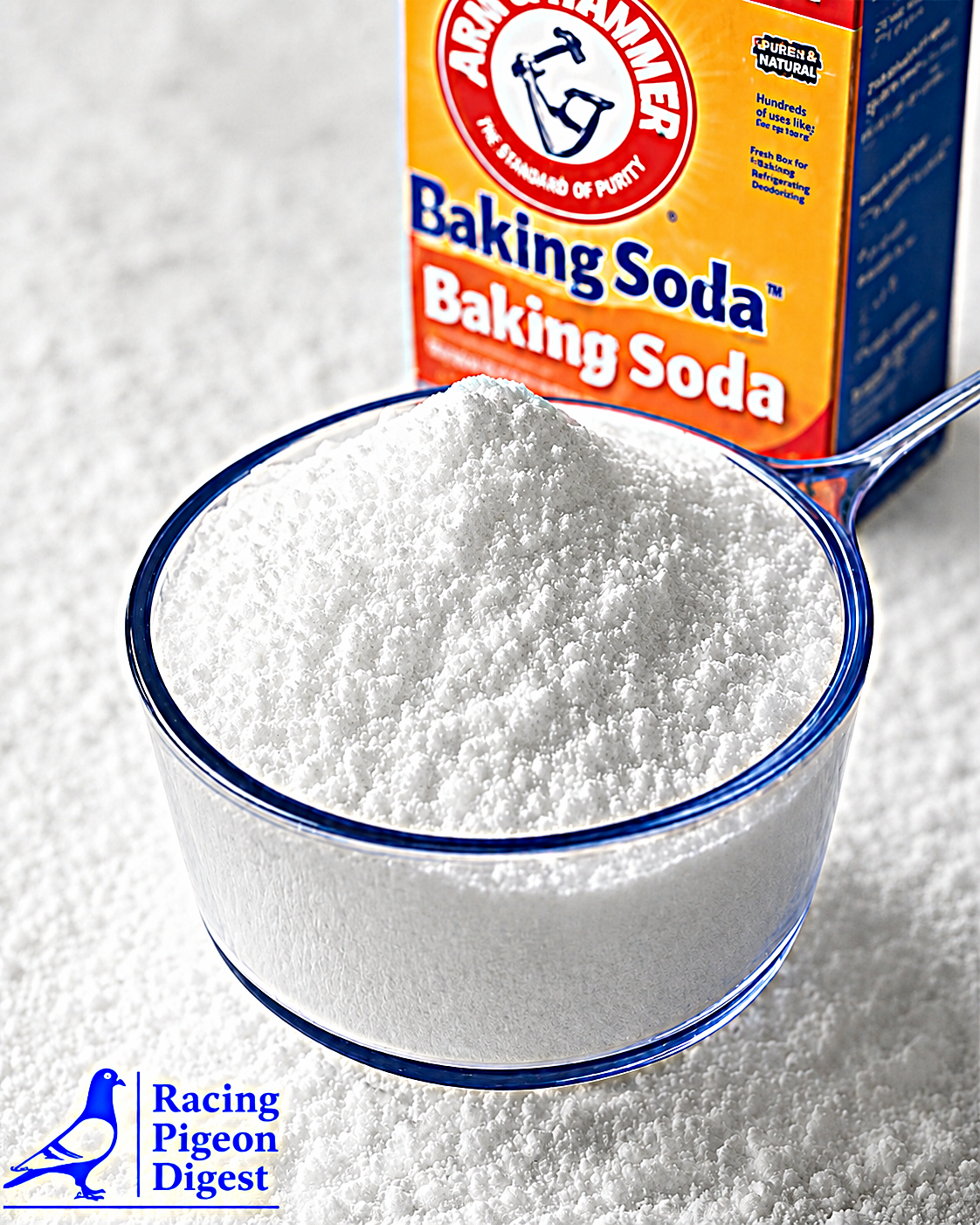
For generations, some of the sharpest fanciers have quietly used an old, inexpensive secret after a hard training toss or race — baking soda. You’ll find it in every kitchen, but behind the loft doors, it’s been a recovery staple for decades. Why? Because it works — and the science backs it up.
The Science Behind the Scoop
When pigeons fly long and hard, their muscles produce lactic acid, just like human and animal athletes. That acid buildup leads to fatigue and soreness — a state called metabolic acidosis. Baking soda (sodium bicarbonate) acts as a buffer, helping neutralize that acid so the body can bounce back faster.
This same principle is well documented in other sports. Human athletes take sodium bicarbonate before short, high-intensity efforts — sprints, rowing, cycling — to delay fatigue and reduce the burn. It is one of the few proven, safe, and legal ergogenic aids in sport science.
In horse racing, it became notorious as the milkshake. Trainers found that bicarbonate allowed horses to run harder, longer, and faster by buffering lactic acid. But it came at a cost: over-amped horses risked muscle strain, ligament stress, and soft-tissue damage, so racing commissions banned it. Today, horses are even tested for elevated blood CO2 levels to detect milkshakes.
What About Pigeons?
Here is where things get interesting. Unlike the tightly regulated world of horse racing, the American Racing Pigeon Union (AU) currently has no anti-drug or performance-enhancing policy banning substances such as baking soda.
That does not mean fanciers are doping their birds — it means baking soda remains a legal, old-school recovery aid. And considering its proven buffering effects in both human and equine athletes, it is easy to see why top flyers still rely on it after a tough race.
How the Comparison Holds Up — and Where It Doesn’t
One key difference: humans and horses take baking soda before exertion, typically 1–3 hours prior, to prevent acid buildup during activity. That timing is not practical — or ethical — with racing pigeons. We cannot dose them before a release or mid-flight.
So, the next best opportunity is after the race, once the birds are home and rehydrate. At that point, the muscles are acidic, glycogen stores are depleted, and bicarbonate can help the body recover and restore balance rather than boost performance.
When Should You Offer It — Right Away or the Next Day?
This is a fair question that divides opinion. Some fanciers prefer the birds’ first drink home to include baking soda, reasoning that it immediately starts neutralizing acid and speeds recovery. Others, including most veterinary and product sources, suggest waiting until the following day, when the birds’ crop and digestion have settled and they are no longer severely dehydrated.
- Fluid loss vs. electrolyte loss. Pigeons do not sweat, so they do not lose electrolytes the way mammals do. What they lose during a race is fluid, through respiration, and glycogen, or muscle sugar stores. Their first drink home should therefore contain simple sugars, such as honey or grape sugar (glucose), to quickly replenish energy and restore hydration.
- Buffer second. Once hydration and sugar levels normalize, within 12–24 hours, a mild bicarbonate solution can safely support acid-base recovery without upsetting the digestive system or altering the crop’s natural pH.
If the first drink contains too much sodium bicarbonate, birds may drink less or experience mild digestive upset. So, while immediately might sound optimal, physiologically, the following day is safer and more effective for most lofts.
Dosage and the Problem of Anecdote
Here is where we need to be honest: pigeon dosage recommendations for baking soda are mostly anecdotal — passed from one generation of fanciers to the next. There is little controlled research on exact avian dosages.
However, based on what is known in humans and horses — where effective doses typically range from 0.2 to 0.4 g per kg of body weight — and scaled appropriately for a small bird’s mass and water intake, the best practical, conservative approach for pigeons is much milder than the old tablespoon-per-gallon rule of thumb.
The Best Approach, Based on the Evidence We Have
- Use: Offer after hard races or intense training tosses — ideally the day after the event.
- Mix: Use about 1/4 teaspoon per liter, or roughly 3/4 teaspoon per gallon of fresh drinking water, fully dissolved.
- Duration: Offer for one day only, then return to plain water.
- Optional: Provide a second drinker with plain water so birds can self-select.
If you are experimenting with baking soda for breeders or non-racing birds as a purge, keep in mind that practice is entirely anecdotal. There is no scientific evidence that it detoxifies or improves breeding performance. For those cases, stay near the same 1 g per liter rate and limit use to a single day.
The Bottom Line
Baking soda is not magic — and it is not a miracle tonic. But used sparingly, safely, and at low concentration, it can help racing pigeons recover faster, rehydrate more efficiently, and restore muscle balance after exertion.
It is one of those old loft secrets that never really went away — because, when used wisely, it still works.
Loft Tip
For an easy and affordable way to boost your birds’ feathers and skin health, try this old fancier’s trick: mix one tablespoon of regular table salt and one tablespoon of baking soda into a five-gallon bucket of bath water. Offer this solution as often as you normally provide baths. It not only helps eliminate lice and other pests but also improves feather quality and removes scale and dead skin. You’ll notice a visible difference in your birds’ overall condition and vitality — and save money while doing it.
Until next time, Drew